
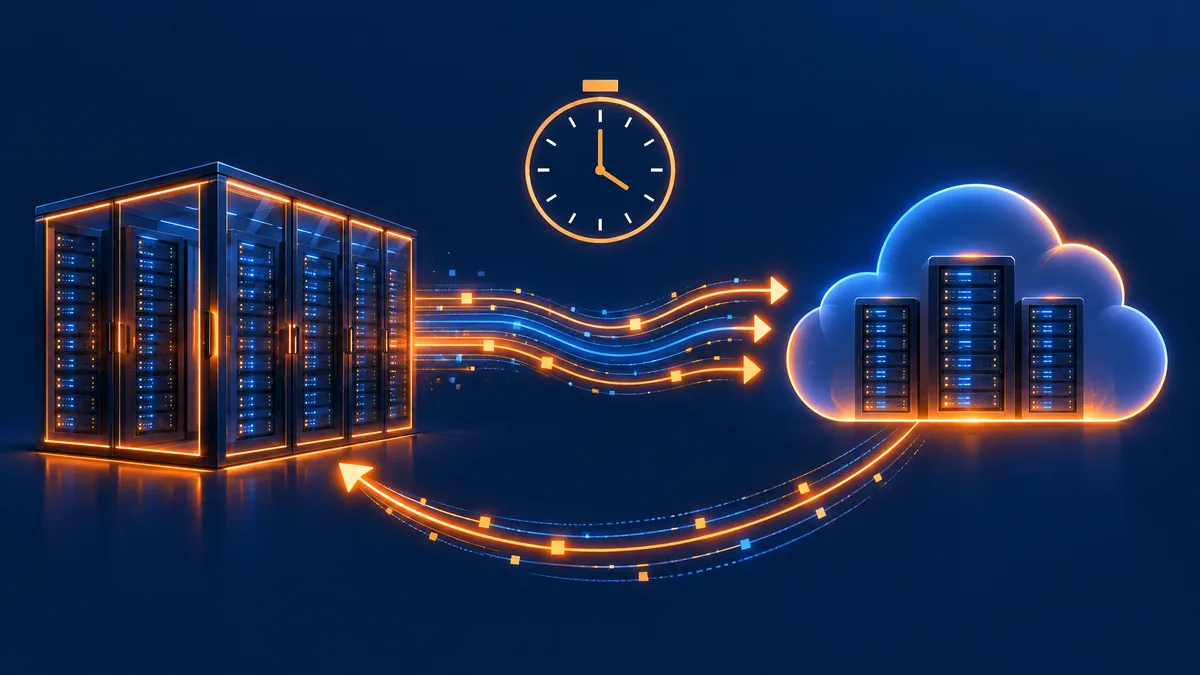
When an outage hits, two questions come up first: how quickly will systems be back, and how much data will we lose? The business answers to these are the RTO and RPO targets. Disaster recovery investment made without defined targets is either more expensive than necessary or leaves critical systems under-protected. In this article we explain how DRaaS relates to business continuity, how RPO/RTO targets are set through business impact analysis, and how those targets shape the architecture.
Are business continuity and disaster recovery the same thing?
Business continuity is a broad approach aimed at keeping critical business processes running during and after a disruption. Backup, disaster recovery and high availability are its components. Disaster recovery (DR) focuses on bringing systems back up in a secondary environment after an outage or disaster. DR is therefore part of business continuity; it does not replace a business continuity plan on its own.
What is DRaaS?
DRaaS (Disaster Recovery as a Service) is a service model that keeps copies of production systems ready in a secondary cloud environment. In an outage, workloads fail over to that environment, and when the primary environment is ready you fail back. Instead of building your own second data centre, you consume that capacity as a service.
What are RPO and RTO?
- RPO (Recovery Point Objective): the acceptable data loss window. It answers how much data, counted back from the moment of the outage, you can afford to lose.
- RTO (Recovery Time Objective): the acceptable downtime. It states how soon after an outage a system must be serving users again.
Both are business decisions, not technical ones. The technical team designs an architecture that meets them, but the targets themselves come from the balance of risk and cost that the business units accept.
How to determine RPO/RTO targets
- Inventory systems and processes: Identify which applications feed which business processes and how they depend on each other.
- Run a business impact analysis (BIA): Assess, over time, what the loss of each process would mean for revenue, reputation, operations and compliance.
- Tier your systems: Giving every system the same target creates needless cost. Define tiers such as critical, important and deferrable.
- Get targets agreed with business owners: Decide by showing that tighter targets bring higher cost.
- Design the architecture to the targets: Replication method, readiness level of the secondary environment and failover steps follow from the targets.
- Test and update: Targets are only validated by the real recovery time and data loss measured in tests.
Why tiering matters
Choosing the tightest RPO/RTO for every system strains both the budget and operations. With tiering, the most critical systems use faster recovery methods while less critical ones are protected with looser targets and more economical methods. Which tier maps to which target varies by organisation, sector and regulation. At Cloud Expert, targets that vary by tier are likewise clarified after the business impact analysis and set out in the contract.
How targets shape the architecture
As data loss tolerance shrinks, replication must be more frequent and continuous. As downtime tolerance shrinks, it matters more that the secondary environment is kept ready, failover steps are automated and runbooks are current. Backup (BaaS) completes DR by providing recovery points in scenarios such as data corruption, accidental deletion and ransomware. That is why backup, DRaaS and high availability should be evaluated together.
Ransomware and regulatory expectations
Recovering from a clean secondary environment is one of the most frequently cited DRaaS use cases in ransomware scenarios. Many sectors also expect a disaster recovery plan to exist and be tested regularly. Confirm the targets and test frequency your own regulations require in writing, from the relevant regulatory text and your compliance team.
Testing: where the plan earns its value
A written DR plan that has not been tested is an assumption. Planned failover tests validate recovery scenarios without affecting production, expose gaps in the runbook and show whether the RPO/RTO targets are realistic. Findings should be fed back into the plan after each test, and targets updated where needed.
Questions to ask a DRaaS provider
- How are RPO and RTO targets defined in the contract, and by which tiers?
- Who carries out failover and failback, and where are the responsibility boundaries?
- How are test frequency and test reporting handled?
- Where is the secondary environment located, and does it meet your data residency requirements?
- How are the scope of monitoring and the scope of incident response each defined, separately?
DRaaS and business continuity with Cloud Expert
In its DRaaS service, Cloud Expert designs, tests and manages replication, failover and failback processes. The process starts with a business impact analysis: critical systems and acceptable outage and data loss windows are identified, the architecture is built around those targets and validated through planned tests. RTO/RPO targets are made explicit in the contract.
For details see our DRaaS and Business Continuity pages, and for services to consider alongside them, BaaS and IaaS.
Frequently Asked Questions
What is the difference between RPO and RTO?
RPO is the acceptable data loss window at the moment of an outage, meaning how recent a point your data must be recoverable to. RTO states how soon after the outage a system must be serving users again. RPO relates to data loss and RTO to downtime, and both should be set through a business impact analysis.
Are DRaaS and backup (BaaS) the same thing?
No, they complement each other. Backup lets you restore data to an earlier point, which matters for data corruption, accidental deletion and ransomware. DRaaS lets you bring systems back up in a secondary environment. A holistic business continuity approach treats backup, disaster recovery and high availability together rather than choosing one.
Should every system have the same RPO/RTO target?
Usually not. Giving every system the tightest target creates unnecessary cost. It is more balanced to first group systems into tiers such as critical, important and deferrable through a business impact analysis, then define a separate target for each tier. Targets vary by tier and are settled according to the risk and cost balance business owners accept.
What is a business impact analysis (BIA) and why is it needed?
A business impact analysis assesses, over time, what the loss of a process or system would mean for revenue, operations, reputation and compliance. RPO and RTO targets rest on its output. Targets set without one are assumptions and can lead either to expensive over-protection or to protection that is too weak for critical systems.
How often should a DR plan be tested?
The right frequency depends on how critical the system is, how quickly it changes and the regulations you are subject to. What matters is that tests are regular, results are measured and findings go back into the plan. If your regulation prescribes a test frequency, confirm it from the regulatory text and your compliance team; planned failover tests can run without affecting production.
Can DRaaS help with recovery after ransomware?
Yes, when designed properly. Recovering from a clean secondary environment is one of the DRaaS use cases in ransomware recovery scenarios. Effectiveness still depends on the replication design, on recovery points being available and on the recovery plan having been tested, so it should be planned together with backup rather than as a stand-alone measure.
Related Services
Explore the Cloud Expert services related to this topic: